
After visiting the central court, we come across the magnificently built Diwan-i-Aam further down. As the name suggests, it was a hall constructed for the general public. Mughal Emperor, Shah Jahan, used to address the people and hold hearings to resolve their grievances in this hall.
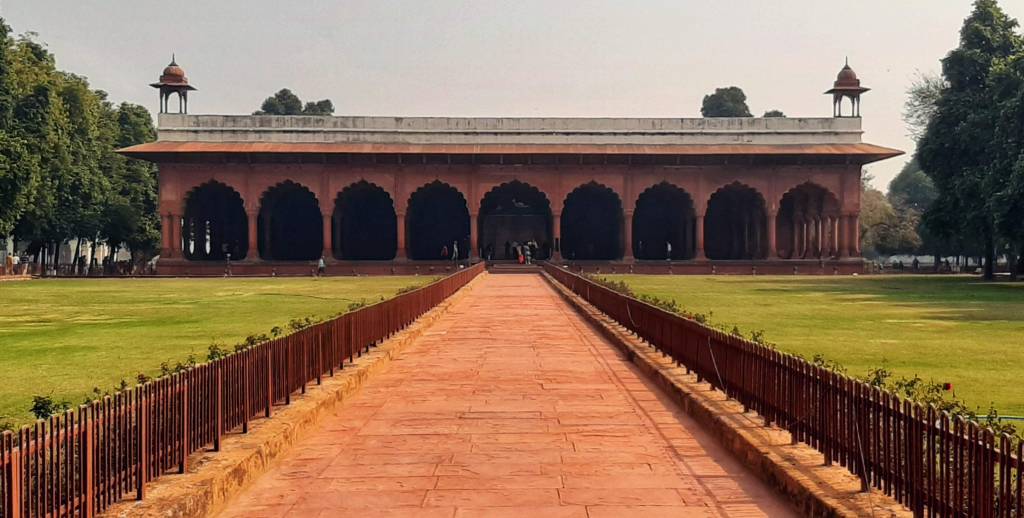
Diwan-i-Aam
We were astounded by the intricate patterns on the stone walls. Diwan-i-Aam comprises an open hall with a set of rooms made of carved red sandstone. Moreover, the frontage of the nine engraved vaulted arches compliments the whole structure.

Behind the marble canopy located in the centre of the eastern wall, is a wall which is ornamented with many-hued pietra-dura stones. The area is symmetrical. The proportions of this hall, columns and arches show fine craftsmanship. In the centre sits the throne of Shah Jahan on a high platform under a marble canopy, which is now covered with glass.
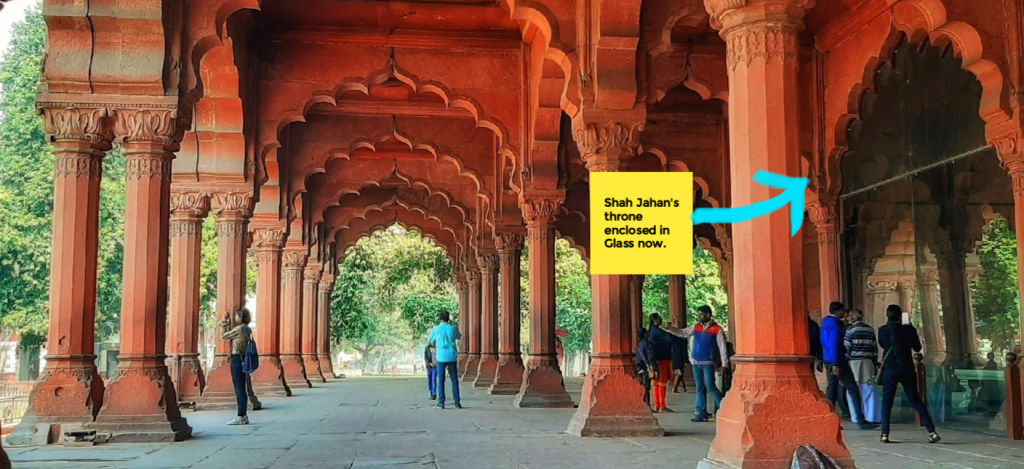
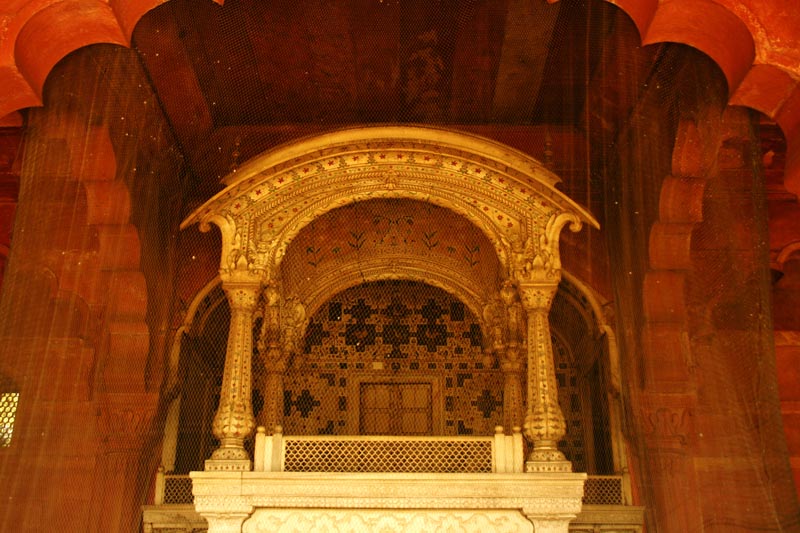
The Marble Throne at Diwan-i-Aam
picture source : Google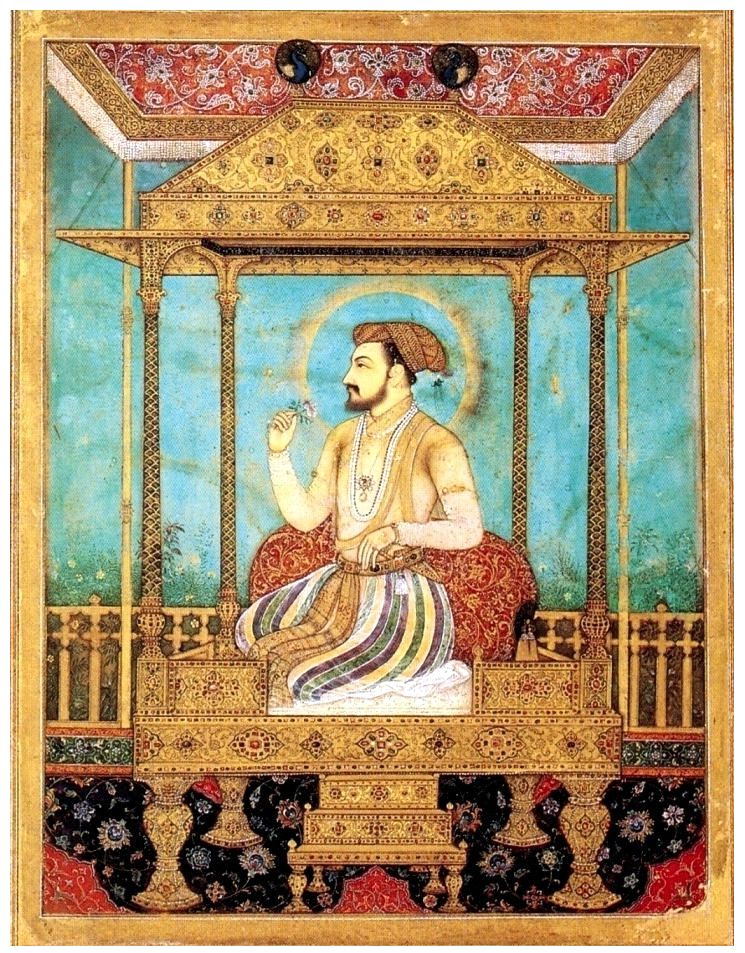
Shah Jahan seated on a minor throne, which probably shared some stylistic elements with the Peacock Throne
source – Wikipedia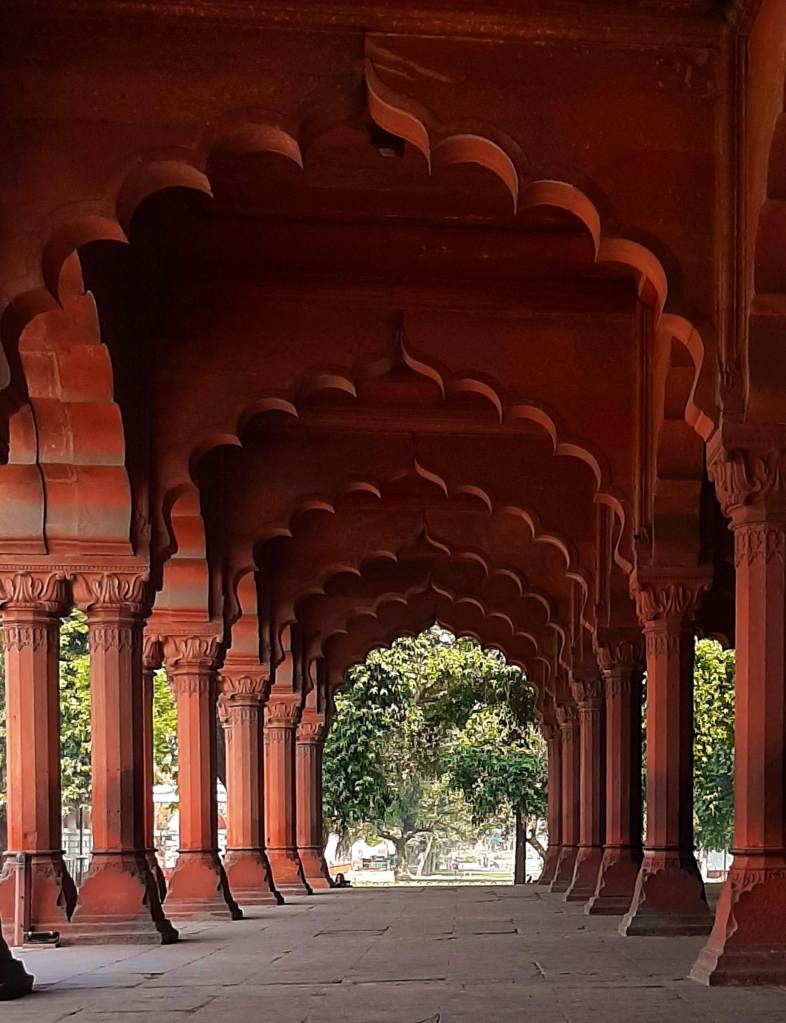
The perfect symmetry at Diwan-i-Aam
The most glorious attraction of the Red Fort is located in the Diwan-i-Aam i.e. Shah Jahan’s built-in throne made from white Makrana marble. The extravagant beauty of this throne represents fine craftsmanship. We were highly intrigued by the beautiful display of the skills with which Diwan-i-Aam is made.
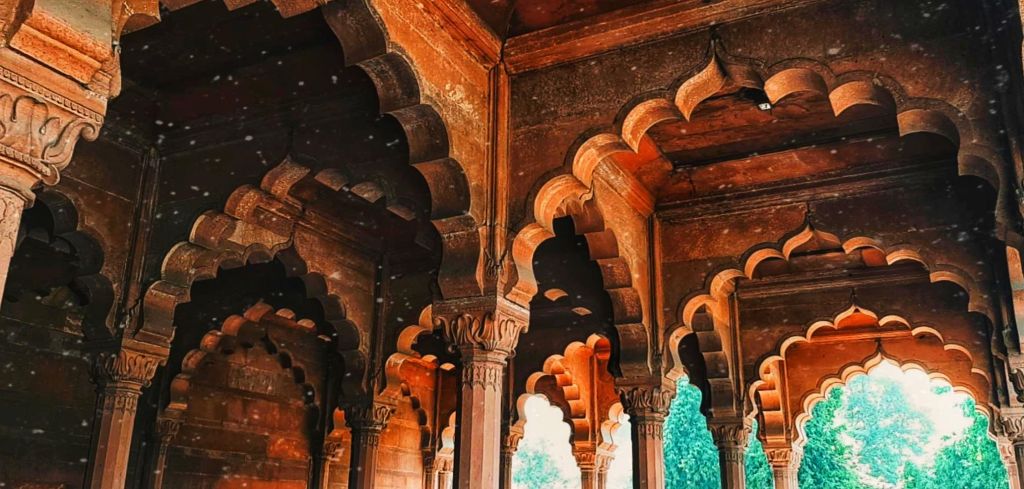
Red Fort stands as a prime example of the fact that with the advent of the Mughals in India, a new era comprising of spectacular architectural work came into being. It is not only a representative of the grandness of The Mughals but also the vast and diverse cultural history which they brought with themselves.
***
While we were still beholding the place, We came across a gate on the northern side of the foregoing Diwan-i-Aam hall, which led us to to the Diwan-e-Khas or the hall of the private spectators.
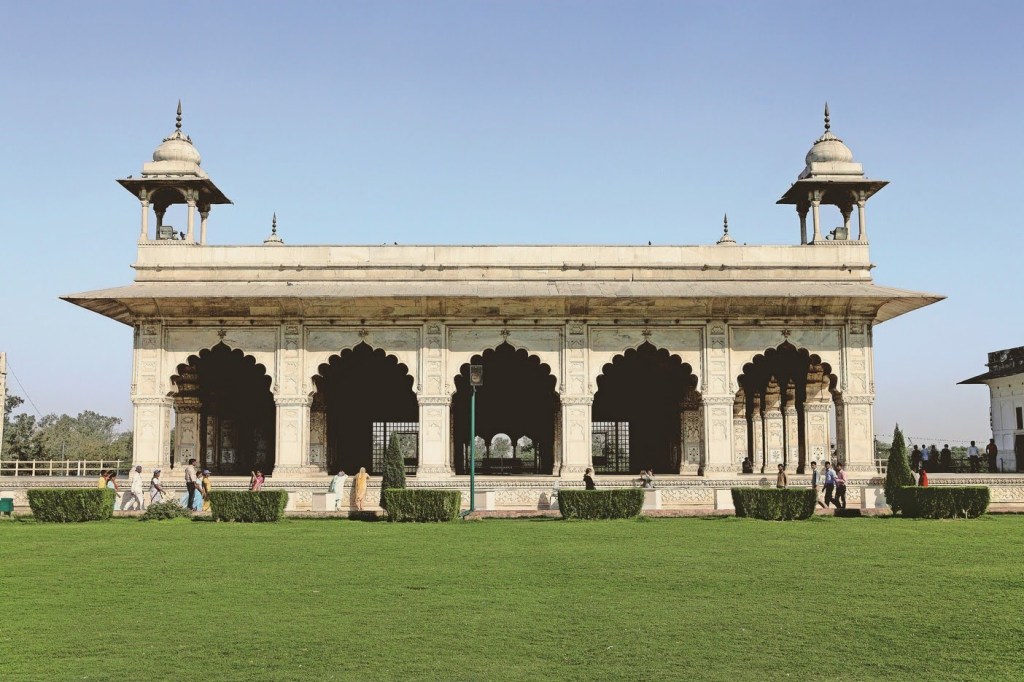
Diwan-e-Khas
Also known as the Shah Mahal, it was a deluxe chamber where the emperor used to greet all the special guests, high ranked ministers and was the venue of all the royal celebrations. It is said that while the emperor used to address the gatherings here, the whole hall was draped with heavy curtains throughout the time.
The well-known Persian couplet of the renowned medieval poet of Delhi, Amir Khusro, who had described the city as ‘heaven,’ is inscribed on the Diwan-e-Aam:
“Gar firdaus bar roo-e zameen ast, hameen ast-o, hameen ast-o, hameen ast.”
Which translates to –
अगर स्वर्ग इस पृथ्वी पर मौजूद है, तो यहीं है, तो यहीं है, तो यहीं है
“If there’s a paradise on Earth, it is this, it is this, it is this.”
Although Khusro had originally written it in praise of the culturally rich city of Delhi, Shah Jahan decided to get it inscribed on the walls of Diwan-e-Khas to express his profound appreciation for the Fort.
Such was the beauty of this place which mesmerized anyone who visited it, including us.

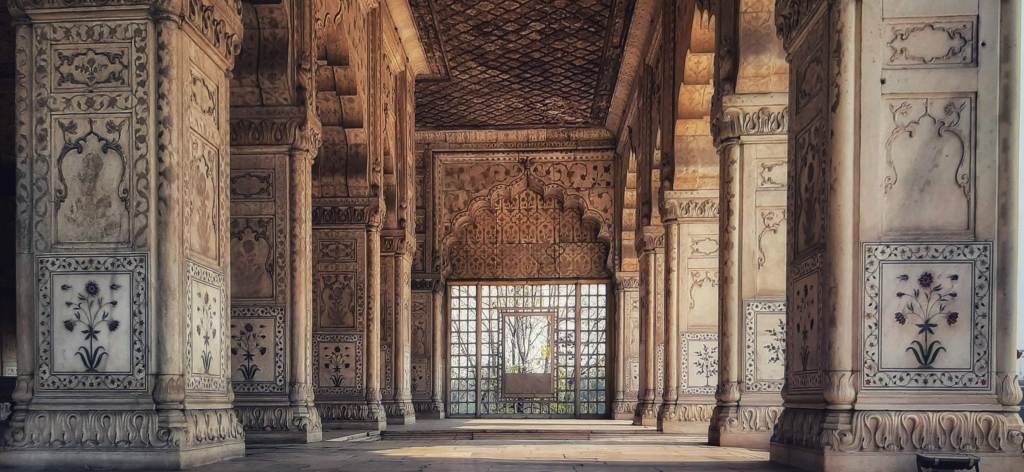
The structure comprises of a series of arches emerging from piers made of marble, which encircle a rectangular central chamber. The bottom of the pier is decorated with floral designs whilst the upper, is painted and gilded. The four-cornered roof is embellished with Chattris.

Peacock Throne Illustrated
source : Wikipedia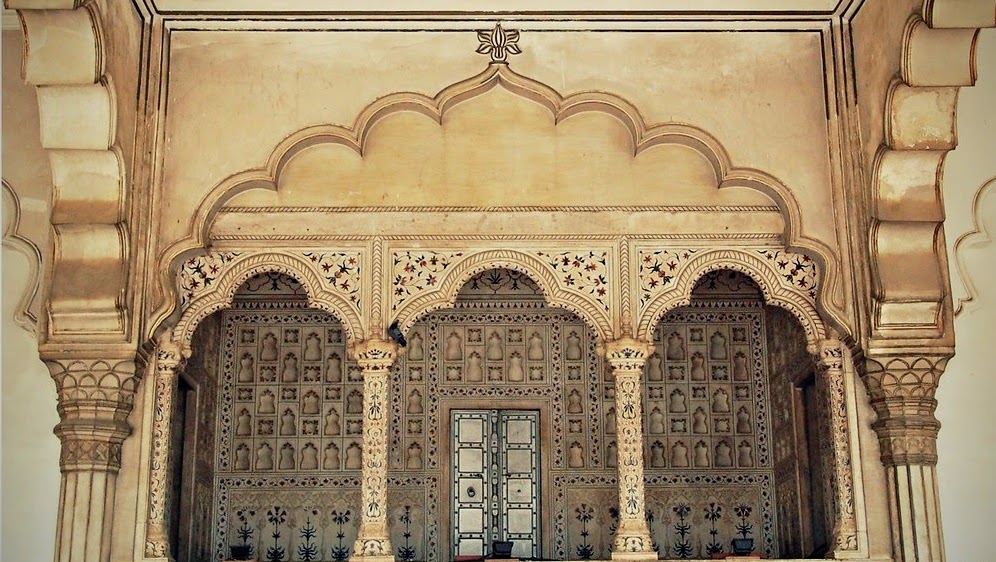
The place where peacock throne was kept before plunder of Nader Shah in Diwan-e-Khas
However, the most fascinating part of the Diwan-e-Khas was taken away to Iran by Nader Shah. It was the Peacock Throne made of gold, which glittered with precious stones. We found Diwan-e-Khas to be the most ornamented structure in the entire Red Fort. It is indeed a splendid combination of local architectural traditions intertwined with Islamic designs and creativity. Unfortunately, we couldn’t enter the hall as maintenance work was in progress at that time.

The Persian king Nader Shah seated upon the Peacock Throne with members of the court, after his victory at the Battle of Karnal
Out of all, we found Diwan-e-Khas to be the most ornamented structure in the entire Red Fort. It is indeed a splendid combination of Indian Architectural innovation intertwined with Islamic designs and creativity. The unusual lavishness which it represents is something highly admirable.
***
We selected the Red Fort for our project ‘Rediscovering Delhi’ due to our interest in Mughal architecture and history and also because in the first semester we had enrolled for a course called ‘Delhi though the Ages;’ so, our knowledge of how Shahjahanabad had evolved and shaped what Delhi is today, also influenced us.
The entire experience was rather strange, yet it also made us feel a deep sense of belonging. In Hindi, it is called: अपनापन
Taking baby steps towards learning more about Delhi, we realized that our city has always been extremely rich in history and architecture. We might think we know Delhi inside out, but this city never ceases to surprise. It overflows with unexplored places; every nook and corner, every street has its own glorious tale.
From Hindu Kings to Muslim Sultans, the reins of the city kept shifting from one ruler to another. The soil of the city smells of blood, sacrifices and love for the nation and its people. Delhi enjoyed a special reputation throughout the ages. From its legendary origins as Indraprastha, the capital of the Pandavas in the Mahabharata, to the period when it became Shahjahanabad during the time of Mughals; then during the British Rule in India, Delhi remained the Imperial Capital; Red Fort is undoubtedly the most prominent symbol the Mughal grandeur, and still stands proudly in its magnificence.
***
Written and Compiled by Ananya Tyagi and Pari Jain
 Rediscovering Delhi