
“Sadaqallahul-Alliyul-Azeem’
Sadqa Rasulu-un-Nabi –Yun- Kareem
Sallallaahu Alayhi Wassallam”
The Dargah of one of the most revered Sufi saints of Delhi, Khwaja Nizammudin Auliya, is truly an abode of peace. Its serenity, ironically, comes from the hustle bustle of its surroundings. Situated in the Nizamuddin West area of Delhi, the streets leading to the Dargah are dingy and crowded.
A lively market welcomed us as we reached Nizamuddin West. Crossing the congested and noisy market place was not really a pleasant experience; but when we entered the Dargah, the perfume of roses enchanted us. Built in 1325, the premises include the shrine of Hazrat Nizamuddin Auliya, the tombs of Amir Khusro and Mirza Ghalib; the grave of Jahanara, the Mughal princess, among many others.
The structure of the Dargah consists of a chamber with walls covered with intricate engravings. The dome atop the tomb is decorated with black marble and a lotus crest crowns the entire structure. The red sandstone structure of the Dargah has now been covered with paintings. Right across the entrance of the Dargah, a heavy wooden door leads to the ancient room. This room of the Dargah, locked up mostly, is opened only for special occasions and exclusive Sufi gatherings.
The marble tomb of Hazrat Nizamuddin’s most famous disciple, Amir Khusro, is nearby and is said to have been constructed in 1605. Next to the tomb of Amir Khusro lie the grave of Jahanara and the tomb of Muhammad Shah Rangila. It is interesting to note that the grave of Jahanara is covered in grass in accordance with the inscription written on the grave: “Let nothing cover my grave, save the green grass/ for grass well suffices as a covering for the grave of the lowly.”
‘Rockstar’ (2012), a hit Hindi movie, had a beautiful song ‘Kun Faya Kun’ filmed in the courtyard of the Dargah. The song evokes the spirituality of this place beautifully. The scenes of the Dargah and the melody of the song together resulted in the creation of a masterpiece. Various other qawwalis of Bollywood movies have been filmed here, including those in ‘Bajrangi Bhaijaan’ (2015) and ‘Ahista Ahista’ (2006). The beauty of the Dargah isn’t the only reason behind why artists want to amalgamate it in their art; it is really a desire to recall its spiritual power that inspires so many of Amir Khusro great verses that are the ultimate ode to art and divinity. He believed that he is lost in the love for the almighty. One of the most celebrated verses of Amir Khusro expresses his relationship with god in the following words:
“Chhaap tilak sab chheeni ray mo say naina milai kay
Chhaap tilak sab cheeni ray mo say naina milai kay
Prem bati ka madhva pilai kay
Matvali kar leeni ray mo say naina milai kay “
(“You’ve taken away all my frivolous desires, my identity, by just a glance/ by making me drink the love-potion; you’ve intoxicated me by just a glance”)
Hazrat Nizamuddin Dargah embodies hope and faith for thousands of pilgrims who come here from all across the world to seek the blessings of the Saint and to enjoy the beauty and peace it offers. Evenings here are often celebrated with qawwalis and folk songs. The legend of the Dargah inspires awe. A few pilgrims agreed to share their stories that offered insight into their faith. “My daughter was lost at the age of eight; we tried all we could to find her, but nothing was of any use. Finally, we surrendered to the wishes of the almighty and began visiting this Dargah. Two weeks later, my daughter was found by the police. It’s been twelve years now, but every Sunday, you can find me here sitting with a grateful heart,” shared a lady. It is commonly believed by all the pilgrims that whoever comes to the Saint with a clean soul gets what he/she prays for. Such profound faith is indeed empowering.
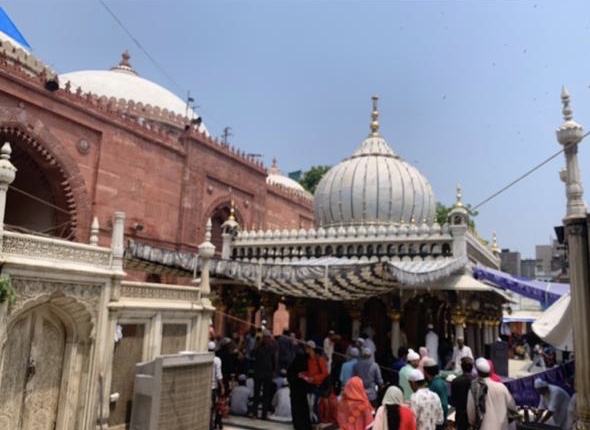
A sunny afternoon in the Dargah of Hazrat Nizamuddin Auliya
By:
Yashkirti
 Rediscovering Delhi