
Drawing millions of tourists every year, the Qutub Minar complex is one of the most important world heritage sites of India. The complex houses a blend of Hindu and Islamic influences suggesting the varied dimensions of India’s royal history. The area has a lush green cover and chirping birds that hop and glide, from pillar to pillar, are a common sight. The Complex houses monuments ranging from the 4th century A.D. to the early 20th century and thus offers glimpses of different eras reflected in the architectural heterogeneity within its walls.
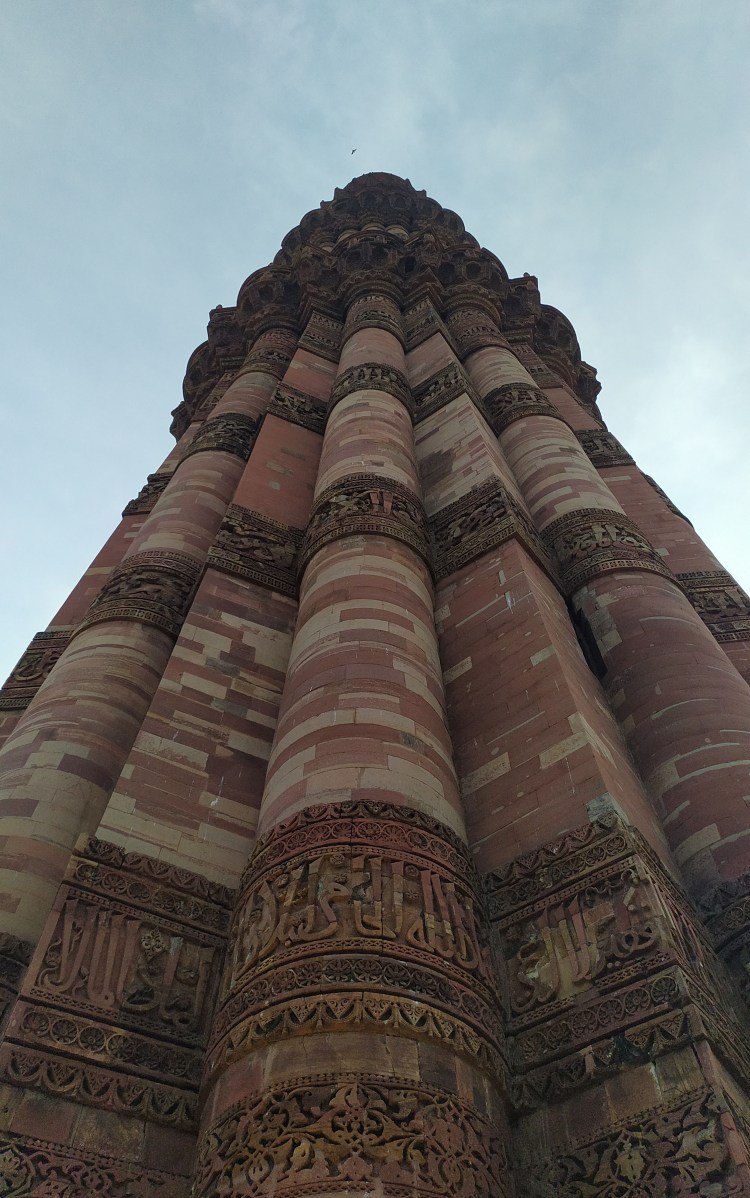
QUTUB MINAR
Amongst the countless historical remains of Delhi, Qutub Minar is the most noteworthy in terms of its architecture, history and cultural amalgamation and evolution of Hinduism and Islam. The ambience of the place is vibrant. One can observe the complex brimming with tourists of all kinds; family groups, tourist guides, school children on heritage walks and the guards of government tourism bodies swarming around the whole area.
There are people who consider Qutub Minar to be the tallest minar made of bricks. We asked one of the guards about his experience of being one of the caretakers of this monument. He answered that, following various incidents of suicide and an accident which took the lives of forty-five people (mostly children) in 1981, as per government orders, the doors of the Minar were closed for tourists. Inside the Minaret, there’s a helical staircase of 375 stairs which lead to the top.
The interior of the Minar has a cladding of red quartzite stone (a decorative stone used in wall covering, roofing etc), which is unique to the Aravalli range of Delhi, while the first three storeys of the Minar have red and buff sandstone cut in rectangular blocks stacked over the column. The remaining storeys are made up of white marble.
What fascinated me most about this monument, is the coexistence of architectural heritage of various faiths. As one comes closer to the Minar, one can observe the arresting charm of the tower and its massive size.
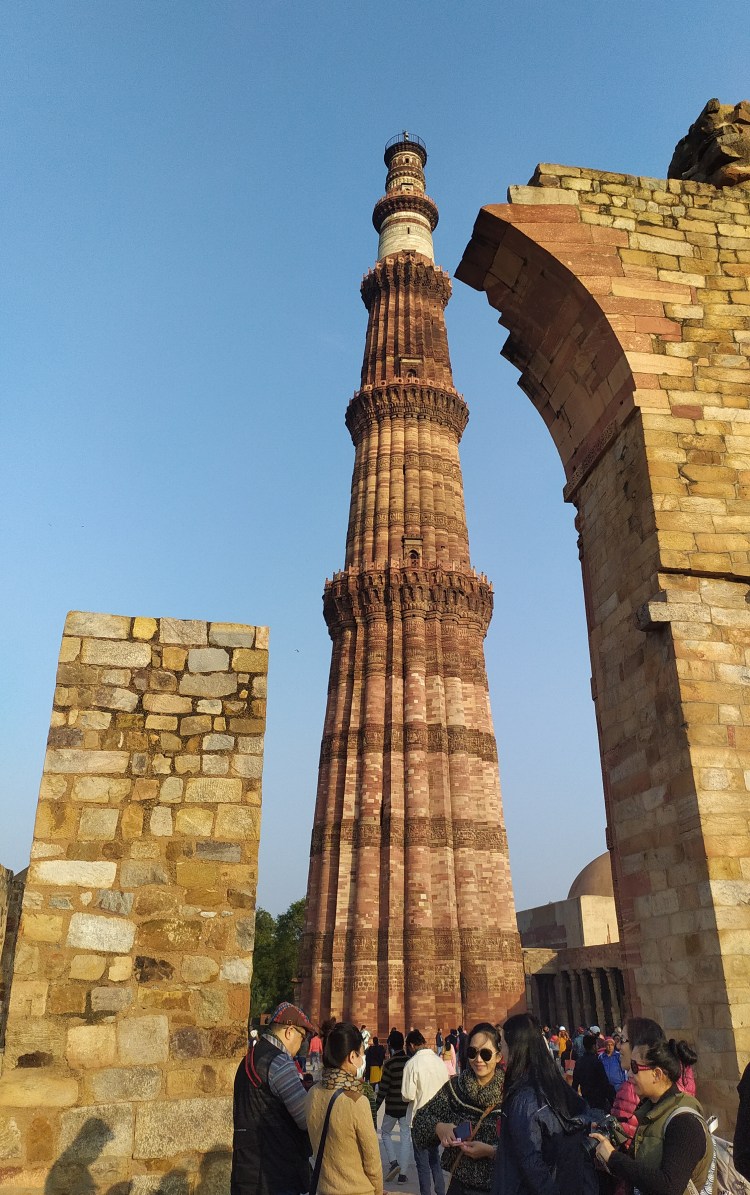
The Minaret served as a place for Namaaz and daily Azaans (call for prayers). Some locals suggested that the Minar could have had military significance, due to its height, to check foreign invasions. A minar is generally found next to a mosque. Similarly, Qutub Minar is located adjacent to Quwwat-ul-Islam Masjid, which is “the oldest and the first masjid of India.”
Qutub Minar is a five-storey tower separated by balconies at each storey. The tower bears arresting calligraphy of Qur’anic verses in naskh as well as Kufic script (decorative Arabic alphabets). The inscriptions on the first storey (above in the picture) resembles the Qur’anic verse-
لا إله إلا الله محمد رسول الله
“La ilaha illAllah Mohammadur rasulallah” in Arabic (which may be roughly translated as : Allah is only one God worthy of worship and Muhammad is his messenger). The inscriptions also praise Muhammad Ghori.

According to the locals, the red stone found in the complex was brought from Rajasthan or Agra. The red stones brought from Agra were ferried through the Yamuna river on boats.
Exquisite patterns, tessellation, patterned brick work and calligraphic pictures adds to the beauty of the Minaret of Qutub. It is important to note that many dynasties added to or altered the Minar.The balconies of Qutub Minar are protruding structures supported by designed corbellings rotating all through the disc of Minaret. The corbel has an extensive arcade structure which increases the architectural beauty of the Minar.
Kanguras (battlement motifs ) crown the walls of the main entrance to the minar. They constituted important decorative elements of the medieval period.
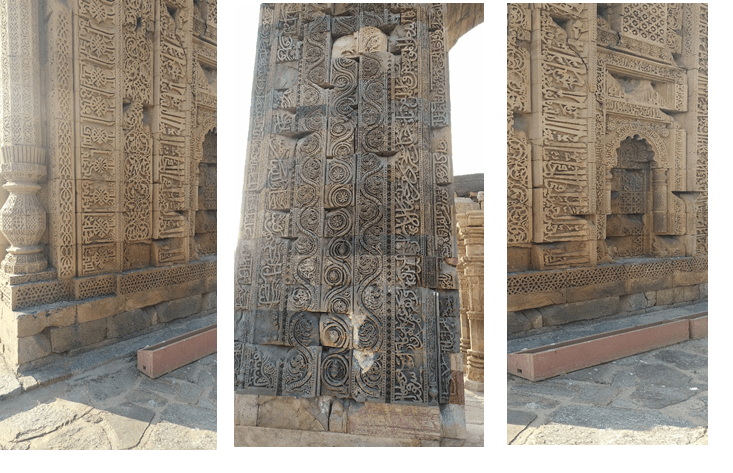
THE TOMB OF ILTUTMISH
A tourist from Haryana claimed that the tomb of Iltutmish was made by his successor and daughter Razia sultan. However, other sources say that it was constructed by Iltutmish himself in 1235. The tomb is built of red stone and white marble. A local security guard said that the actual grave of Iltutmish lies behind this white marble cenotaph and can be accessed through a tunnel, which has been closed by the authorities. “The tourists nowadays are ignorant, they would climb anywhere on a tomb or a masjid to click selfies, without realizing the religious significance of these sites. These are burial sites which house the dead. They’ll be cursed,” said a local security guard who has been working here for years.
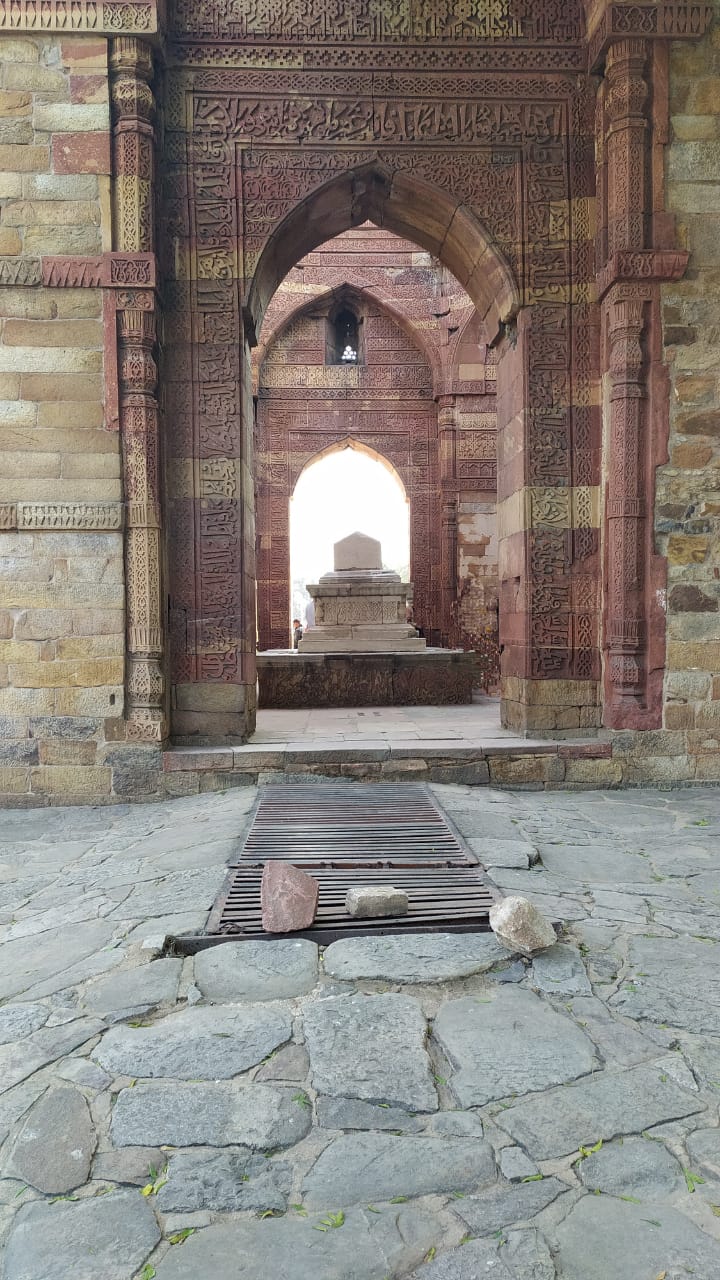
A tourist guide said that people from Afghanistan and other Islamic countries come there in the evening after 5:30 and read namaz in front of the tomb. They believe that their wishes are fulfilled there. Before the Qutub Minar complex came under government tourism bodies, people used to come here bare feet to offer flowers and chadars on the grave of Iltutmish as well as the grave of Alauddin Khilji. All we can see today is tourists hanging around/on the grave and clicking pictures.
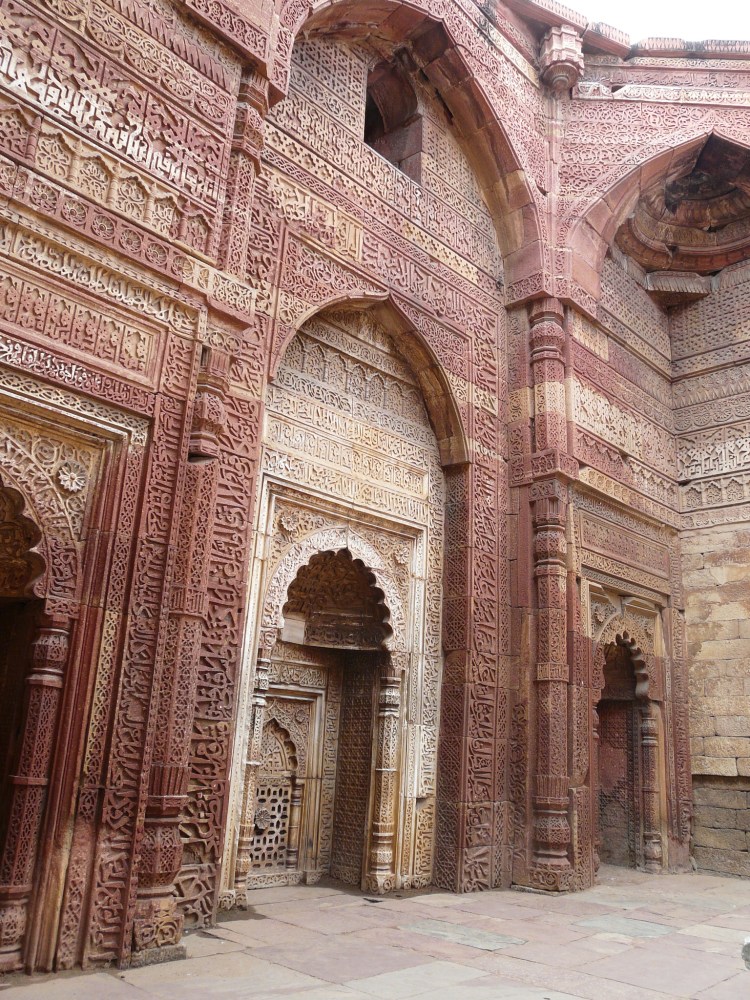
The mihrab of the tomb of Iltutmish is made up of white marble covered with geometric patterns and is divided in three layers. The outermost layer has inscriptions from The Quran. The verses mainly refer to the themes of judgment and the bliss that awaits the faithful. The second layer has a multifold arch standing on two pillars like structures. The innermost has an arch, below which jalis can be observed. A mihrab was used to indicate the direction that Islamic devotees should face while praying.
THE ALAI MINAR
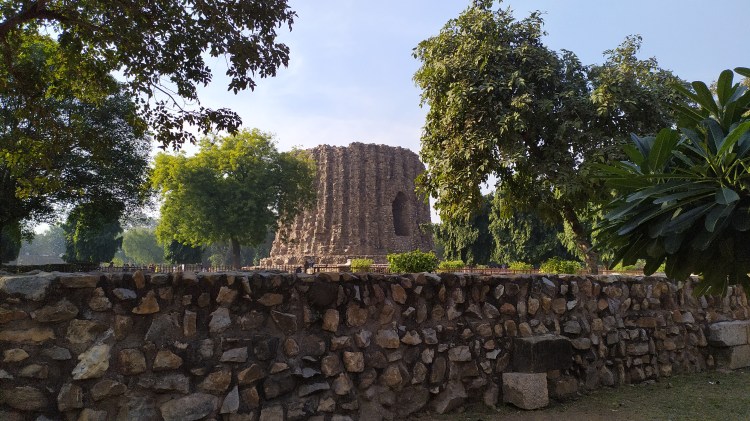
The Alai Minar is a one storey ruined tower situated to the north of the Qutub Minar. The Alai Minar was planned to be twice the size of the Qutub Minar upon completion. Its construction was started by Alauddin Khilji, a sultan of Khilji dynasty. His death before its completion led to the suspension of his plans and none of his successors chose to continue the work further. Today, all we can see is the core of the Minaret covered with rough fragments of stones and rocks. This incomplete Minar symbolises the incomplete aspiration of a highly ambitious king which is now reduced to a carcass of stones.
ALAI DARWAZA
The Alai Darwaza is the southern gate of the Quwwat-ul-Islam mosque. The name ‘Alai’ derives from Alauddin Khilji’s name who constructed it in 1311 A.D. The architecture of Alai Darwaza is said to be purely Islamic and authentic in nature. This was because the Khilji dynasty came years after the slave dynasty, which gave the indigenous Hindu architects time to learn about the Saracenic architecture, which they had not had time to master during the period of Qutubuddin Aibek, whose reign marked the early days of Muslim rule in India. Inside, the Darwaza must have thronged with tourists, foreign as well as people hailing from different parts of India.
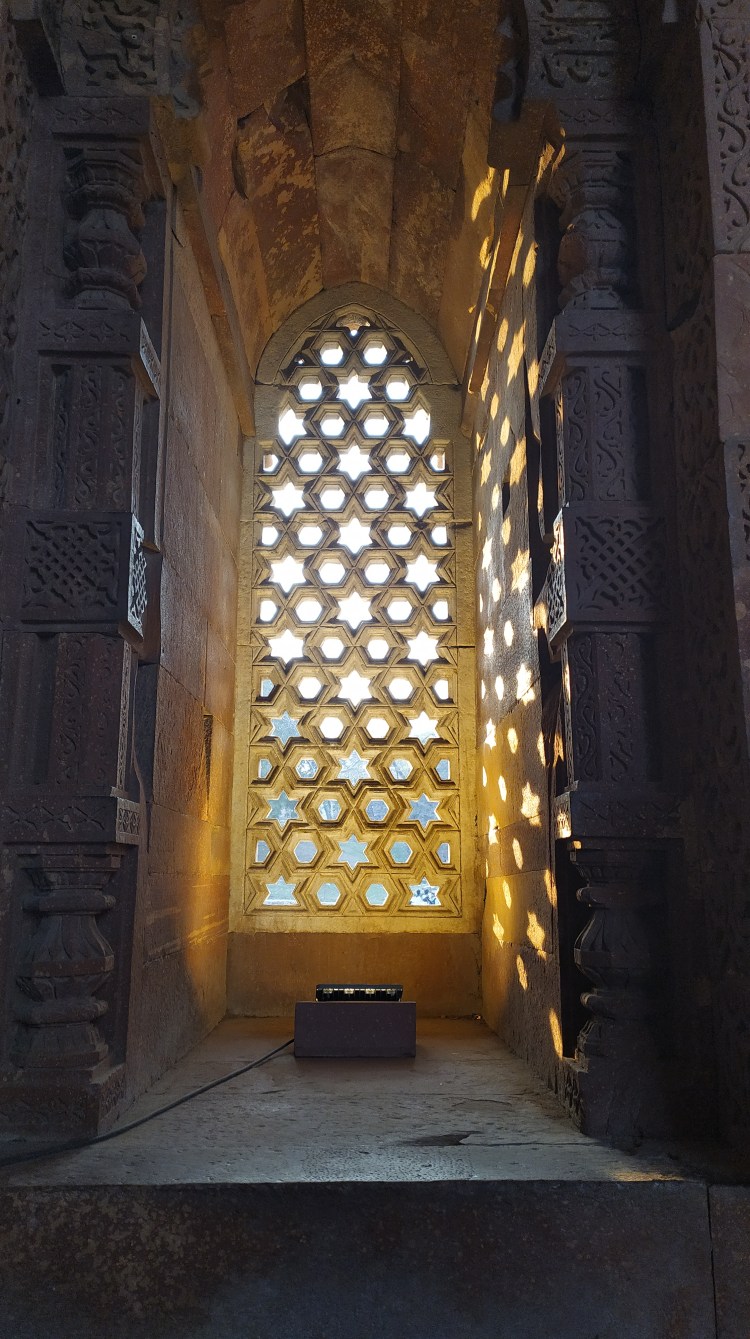
A local security guard said that the Darwaza was used as a meeting place and as a place for conferences where the king would discuss important matters after reading namaz at the mosque. He also added that the dome of the Darwaza is constructed in such a way that one can feel cool breezes in summer and warmth in winters, making it a viable place for regular meeting and greeting of the king and his ministers.


The Arch of the Darwaza is horse-shoe shaped and is covered with lotus-fringes and fine patterned brick patchwork on the borders. The tomb has a sandstone cladding. One can also observe heavily embossed Qur’anic verses on the outer wall and star-combed hexagon shaped jali windows in the Alai Darwaza.
THE IRON PILLAR
Referred to as ‘Keel’ by the local residents, the Iron Pillar is a metallurgical marvel of 4th century A.D. which adds to the beauty of the Qutub complex. The pillar weighing six tonnes was made during the reign of the Gupta dynasty. The total height of the pillar is 24 ft of which 3 ft is buried underground. It is quite fascinating to note that even after almost 1700 years, the Pillar shows no sign of rust on its column. The Iron pillar stands in front of the Quwwat-ul-Islam Mosque, which is an interesting example of religious tolerance of the sultans of Delhi. The Iron Pillar is a testimony to the metallurgical skills of the ancient Indians.
The Pillar has a eulogy of Chandragupta Maurya inscribed on it. During the Gupta period, Vaishnavism was the most followed faith and the pillar was built as a banner for lord Vishnu. It is believed that the souls of the progeny (descendants) of lord Vishnu reside inside the pillar making it so strong that it’s iron will never corrode!
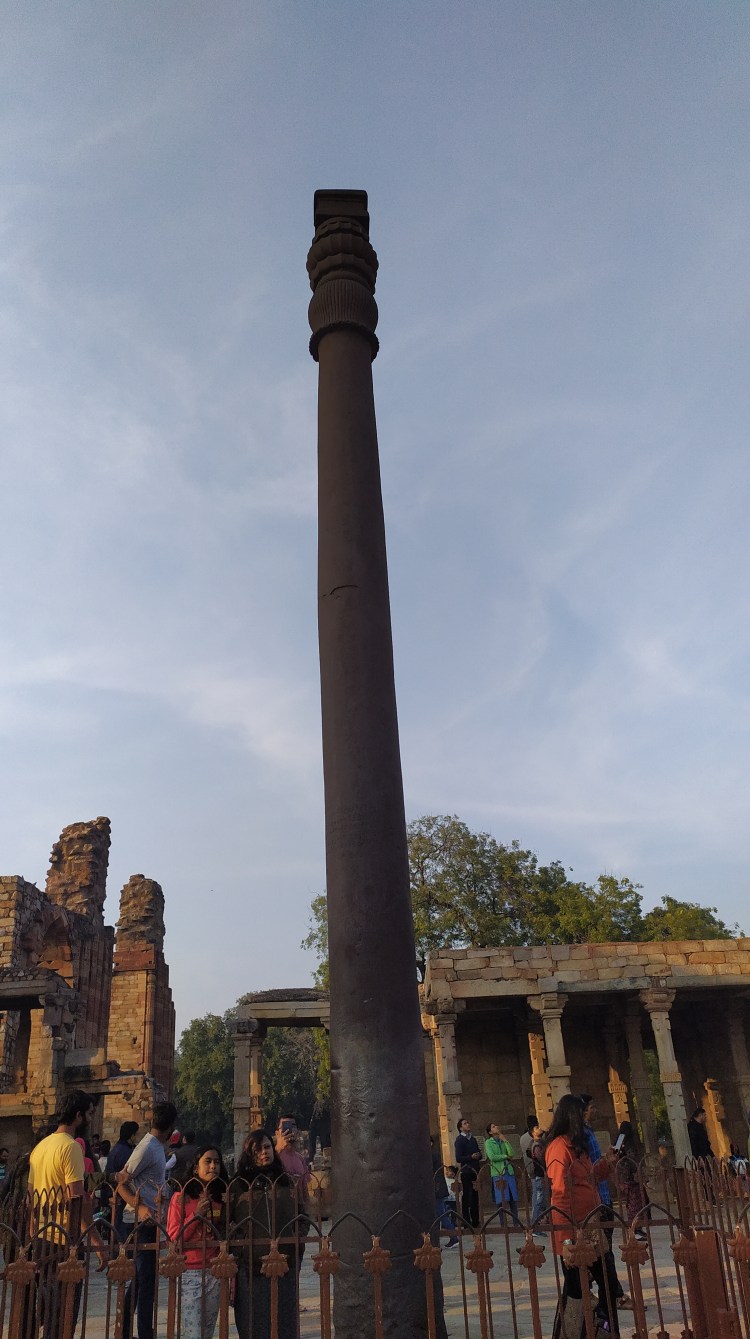
Eavesdropping on a conversation between a tourist and guide, I found that there is a legend associated with the iron pillar. If a person hugs the Pillar backward, they earn good luck and their wishes would be fulfilled. However, now the Pillar is fenced to avoid wear and corrosion due to human contact.
The quadrangle of the Iron pillar is surrounded by many unknown graves on which people make their children stand and click photos/selfies.
Complete the read at The Qutub Complex – Part II.
Compiled by: Nandini Lohia, Ridhima Gandhi and Akansha Bharali
 Rediscovering Delhi
One thought on “THE QUTUB COMPLEX – Part I”