
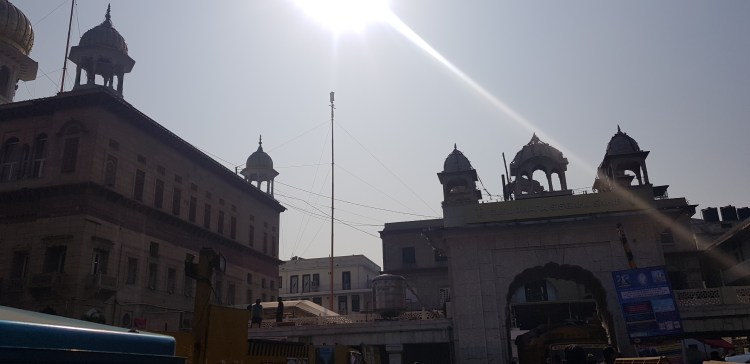
Historical Significance, Cultural Integrity and Changing Social Fabric
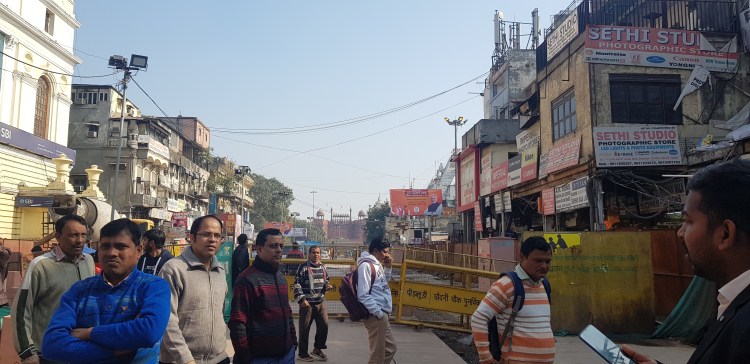
My grandfather fondly recollects stealing free rides on trams when I mention Chandni Chowk. “Just climb onto the back of a moving one and make no noise,” he reminisces. On visiting Chandni Chowk, sadly, I found that the trams were long gone. E-rickshaws now control the transportation business of the area; Rs.10 from the Metro Station to Sis Ganj Gurudwara, Gauri Shankar Mandir or Central Baptist Church. You name the place and they will take you there. However, all these destinations are within one km. radius of the Metro Station, and therefore, easily accessible on foot. Exiting the Chandni Chowk Metro Station for Town Hall will land one directly in the heart of the Chandni Chowk market.
The dusty, narrow roads of Chandni Chowk were originally laid to be the path for royal processions. They have witnessed the royal cavalcade of elephants and horses and the era of trolleys and trams under the colonial government; the hand pulled rickshaws and now, the e-rickshaws.
With the claws of modernity striving to leave their mark on Chandni Chowk and its dense, rich history that is a monument of the endless tug of war between both. It stands as the remnant of a Delhi lost in time; a place jam packed with small lanes and congested markets, not built with the thought of a myriad of motor vehicles traversing its nooks and corners.
Chandni Chowk was established by the Mughal emperor Shah Jahan. It was the capital of his empire and called Shahjahanabad. A pool of glittering water reflecting the moonlight (Chandani) ran from the Red Fort to the Fatehpuri Mosque, which resulted in the name Chandni Chowk. The marketplace was also used as a path for royal processions and was also a hub for important people to meet and buy expensive and rare jewellery and exotic perfumes. The original three markets were designed to lead to the splendid view of the Red Fort. Even today, with the Shahjahanabad Redevelopment Corporation repairing the old establishments, one still gets that perfect view of the Red Fort gleaming in the sunlight. The magnificent fort, visible even from a long distance, stretches across the blue sky, providing a sight that awes amidst the chaos and din of Chandni Chowk.
With the death of Shah Jahan’s son Aurangzeb in 1707, the royal family declined, failing to produce another powerful ruler which led to a long period of instability. Chandni Chowk was repeatedly plundered and invaded without a strong protector. This instability continued till the revolt of 1857. Many structures got destroyed in the resulting massacre. The Khooni Darwaza, less than three km away from Chandni Chowk, was the epicentre of bloodshed.The three heirs of the last Mughal emperor, Bahadur Shah Zafar, were publicly hanged there. Then, the English government imposed strict laws due to which the market suffered immensely.
However, very soon, Chandni Chowk sported a new look when the British remodelled the dilapidated structures in their own vision. Jahanara’s Sarai was demolished to build the Town Hall in 1860-65. The channel flowing through the middle reflecting the moonlight was bricked over. Open spaces were developed for gardens. The Clock Tower was constructed right in the heart of Chandni Chowk, . The arrival of railways had a positive impact on trade. The market started prospering again and some form of stability was restored. The market place became a broad, well-lit shopping area where trams ran through the streets. There were hardly any hawkers, and therefore, it was a lot more spacious.
Post-Independence, as recounted by Dr Vijay Rohatgi, Professor Emeritus at Bowling Green State University, there were many Muslim owned shops located around Ahmad ka Mohalla (present day Krishna Gali). The Hindus (majority being Jains) lived in harmony with the Muslims. But at the time of the Partition, this harmony was destroyed and a majority of Muslims abandoned their home and businesses. The refugees coming from Punjab occupied these spaces instead. Delicacies like kulche chole, and bhature were first introduced in Delhi by these people. The hawker culture was a product of their need to earn a living. The streets grew chaotic and poverty overpowered the once-grand city of Mughals. The poverty never left, but the market soon started flourishing again. Post-Independence Chandni Chowk looks very similar to the present day one, the only difference being the presence of motorised vehicles.


It is remarkable to observe the vast and frequent changes that Chandni Chowk has survived. To reflect the ambitions of its successive masters, it has been remodelled and changed. The architecture of a capital city is a public declaration of dominance and control; yet, Chandni Chowk has never belonged to its maker. It always belonged to the people living in it. The Mughals and the British tried creating a Chandni Chowk in their own image. A place, however impressive, remains distant and cold if there is no public involvement in it. The people of Chandni Chowk make this place a historic and vibrant place worthy of engagement.
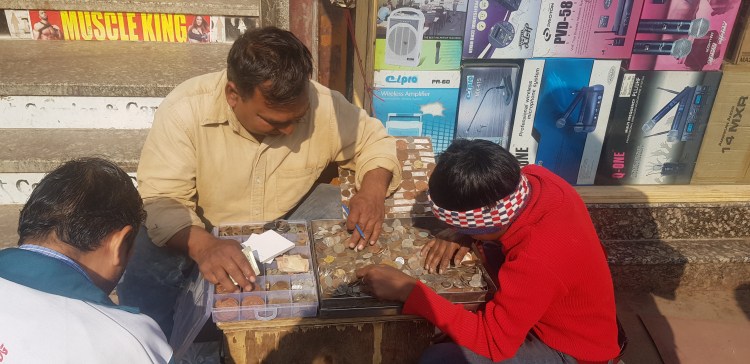
The families living in the kuchas (streets) or the havelis; the mosques, the churches, the temples and the gurudwaras they visit; the food they sell and eat; and the clothes they sell and wear; all this makes up Chandni Chowk. With the passage of time and shifting bastions of power, the people, along with the stone and brick architecture, have been witnesses to dynasties, imperialists and democracy. Still, what is awe inspiring is how the people of Chandni Chowk adapted to all this. Only in Chandni chowk will you find a man selling coins from early Mughal period for Rs. 300, which is the only source of his income, in front of the magnificent building of ICICI bank.
The people working here have also adjusted to the invasion of modernity entering into the small, crooked lanes and eventually into their lives. Centuries old houses have heavy wires hanging from their balconies, all meshed up and connected to the nearest electric pole. Modernity has found a way to coexist with the traditional in these streets. On careful observation, I notice that so have the people.
After relishing Daulat ki chat and piping hot jalebis, we made our way back to the Metro Station. If you want to witness what metamorphosis looks like in real time, I advise you to visit this place. You will not be disappointed.
Written by: Ritigya Malik
Street Food: Uniting Cultures
The bustling streets of Chandni Chowk echo history, culture, food and good times. A ‘must visit’, for anyone who wants to get a taste of Old Delhi, Chandni Chowk is the place to go. Chandni Chowk is famous for a whole range of things like shopping, food, culture and places of religious significance. To taste the true flavours of Delhi’s food, a visit to Chandni Chowk is essential, as it provides an incredible variety of delicacies catering to every taste for affordable prices.
When I visited the place, I was reminded of the anecdotes told by my grandmother about the place. The place maintains its traditional ways even now.
In this report, I have endeavoured to study Chandni Chowk through food. This place is the hub of famous traditional delicacies and a major tourist attraction. Chandni Chowk, translated as ‘Moonlight Square,’ was built in the seventeenth century, and has been serving mouth-watering food ever since.
The narrow lanes are jam-packed with street vendors, peddlers, traditional shops and bazars. It offers more than a thousand kinds of delicacies and sweets. One of its well-known spots is ‘Paranthe Wali Gali’ is a narrow lane with shops on both sides which sells over 80 kinds of parathas and was established in 1875. The parathas are fried in kadhais instead of being cooked on a tawa. Some variety of stuffings are onion, potato, cauliflower, lemon, green chilli, garlic and so on. They are served with 2-3 vegetables, chutney, pickle and raita. Each paratha costs Rs. 30-40. It is one of a kind lane that specialises in the traditional breakfast of every north Indian household that is served with aloo ki sabzi (potato gravy), pickles, chutneys and are accompanied with cold buttermilk which is provided in kulhad (small earthen pots). It is a satisfying meal offered at reasonable prices.


Not too far from ‘Paranthe Wali Gali’ is the famous ‘Natraj Dahi Bhalle Wala’, the shop has been serving finger-licking Dahi Bhalle and chaats since 1940. This shop has won many awards and turned the business into a family legacy.
Food vendors are an intrinsic part of the history of Chandni Chowk. Shops like ‘Mote Lal ki Dukaan’, ‘Jain Snacks and Food Corner’, ‘Shri Balaji Chaat Bhandar’ are some of the other places that offer similar, and equally scrumptious, delicacies.
Daulat ki Chaat, a rare delicacy found in a few places in India such as Banaras and Lucknow, is a big attraction in winter time. This milk, cream and saffron concoction takes six hours to prepare. It’s a seasonal delicacy only available from November to February. The business is run with the help of family members and requires a traditional tool called madani (a special whisk and churner). The vendor of this sweet commented that he generally changes four to five spots throughout the day and earns satisfactory.
‘Bagichi Charandas Charkhewalan’, a favourite of spicy food lovers, sells two types of kachoris, primarily aloo (potato) and daal (split black gram). It is a hidden gem.


‘Jugal Kishore Ramji’, a two hundred years old place run by the eighth generation serves special chaats with sand roasted potatoes.
Another famous delicacy of Chandni chowk is Rabri Jalebi at old famous ‘Jalebi Wala’. The hot jalebis dipped in delicious rabri is a dream of every dessert lover. Khurchan, made from malai (milk fat) is sold exclusively in Chandni Chowk.


As told by a local, the food sector of Chandni Chowk employs around 7.3 million people and is dominated by the unorganized sector, which is 65% of the industry, consisting of dhabas, roadside eateries, hawkers and street stalls.
Many shop owners have refused to adopt modern ways of business, but many wanted to expand and tie-up with companies like Zomato, Swiggy. Cost, however, is as a major concern.
The raw material procurement is done locally to reduce transportation cost. The owner of ‘Jain Snacks and Food Corner’ asserted that these traditional shops are facing a tough competition due to commercialisation from major food chains like Haldirams, Bikanerwala, Giani’s and Burger King. Customers also prefer to order online. The online delivery partners generally refuse to work with them as Chandni Chowk is a congested area, which leads to late deliveries.


Chandni Chowk is a highly price-sensitive market and contributes a significant amount to Delhi’s economy and provides employment to a large number of people. Dynamic consumer preferences are causing the local food shops to suffer. However, due to its rich history and the quality and range of the food it provides, this place still stands on its own. For anyone trying to discover the city of Delhi, this is an essential stop.
Written by: Nitika Yadav
Consumer Relationship: Commerce and Markets
The market was lit with lanterns and lamps that attracted mosquitoes; the air was heavy with the scent of spices. One could hear the noise of the daily traffic, hawkers shouting at the top of their voices and people talking in all sorts of languages. The over-peopled streets of Chandni Chowk were jam-packed with shops, big and small.
This densely populated market has been around for almost five centuries and was once visited by merchants from Turkey, China and even Holland. It has been around since the establishment of Ghantaghar (a huge clock tower) till its demolition.
Just like the medieval times, one can still buy anything, ranging from wholesale to retail goods to curios and souvenirs. One can buy artifacts like ancient coins in the streets of Chandni Chowk to modern equipments like cameras and its accessories in Kucha Chaudhary market. Shopping in Chandni Chowk can be quite an adventure, but one has to be familiar with the art of bargaining.


The market is also known for clothes. Its specialty is not only the affordability of the items available but also their style, design and patterns. The hectic shopping spree starts in the morning and goes on till late in the evening. While some hawkers sell inexpensive merchandise like socks, bags, cheap t-shirts and others, the others sell mouth-watering Indian delicacies such as parathas, jalebi, dahi ke gol-gappe, rabri, halwa, mirch ke pakode, tikki, bhelpuri, ladoos, vada pav and the list goes on.
Many peddlers of Chandni Chowk have been working here for decades. An old peddler, Mukesh, was interviewed by us. On being asked about his children and family, he proudly replied, “my daughter works for a bank and my son for an office in Gurgaon. I sell socks because this is what has fed my family for years and on top of it, I do not like sitting at home. I enjoy coming here, contributing to the family income and meeting people.” There are others like Raju, for whom selling rubber bands, clips and toys is a compulsion due to absence of alternate earning members in the household. He says that his children are addicted to alcohol and do nothing but roam around in his slum in a drunken state. He suspects that they are involved in gambling as well. These peddlers typically earn Rs. 300 to 400 in a day, which is enough to feed their families for a day.


The sight of hawkers sitting in the pavements on mucky mats is not uncommon in Chandni Chowk. One can find professions that can be seen nowhere else; some hawkers sell vintage coins while others are traditional ear cleaners in their typical red coloured headgear. The coin sellers have a variety of coins of all shapes and sizes. Some are square, some oval, some are made of bronze and some of iron. The prices of these coins begin from Rs. 10 and go up to Rs. 500. The sellers initially tell a high price because their customers usually bargain and procure the coins at a price that is at least 20-30 percent less than the one quoted by the peddler. The earnings of these hawkers are less than those of the ones selling items like bags and t-shirts. They are barely able to earn enough for a meal for themselves and their families. Some peddlers also exchange old, torn currency notes for new ones.


The traditional ear cleaners clean ears using a long needle, cotton and a yellowish liquid. They say that they would not teach this skill to their children because they do not earn enough for sustenance. Imran, an ear cleaner in Chandni Chowk, earns Rs. 100 to 150 in a day. He continues doing this work because it has been his family business for decades. He charges Rs. 30 to 50 from each customer, depending on how much bargaining the customer does. Where peddlers openly disclosed their earnings, owners of big shops like ‘Chaina Ram’, ‘Natraj Dahi Bhalle Vala’, ‘Kawarji Sweets’, ‘Old Famous Jalebi Vala’ and ‘Annapoorna Sweets’ were hesitant in declaring their income.
Traders from New Delhi, who own fashionable textile shops, get their supplies from Chandni Chowk. The main street, stretching from Lal Mandir, opposite Red Fort, to Fatehpuri Masjid, has stuff to please all tastes, Indian and foreign. Not only clothes, the market is also famous for electrical goods, jewellery, spices, watches, sunglasses, footwear paintings and pooja (prayer) accessories.
Like a honeycomb, Chandni Chowk is divided into kuchas (lanes), each having its own speciality. Dareeba Kalan, for instance is a seventeenth century market that came into existence during the reign of the Mughal ruler, Shah Jahan. It is famous for its silver, meenakari and kundan jewellery and authentic ittar (perfume). It got its name from a Persian word, Dur-e-be-bah, meaning ‘unparalleled pearl’. The market sells ornaments of incomparable quality at prices that are approximately 30% less than those of other markets across Delhi. The prices of the jewellery start from as low as Rs. 250.
Shops in Nai Sadak, a popular book hub in Chandni Chowk sell second-hand and first hand books that range from fiction in Hindi and English to old yellowing school textbooks. It is also well known for its cheap stationary. A shopkeeper whose family has been in this business for more than eighty years say, “The business is slowing down. We used to earn more before the rise of online markets”.
Kinari Bazar is a gali (a street) ideal for wedding shopping. The street sells Indian wear like lehangas, sarees, kurtas, dupattas and additional dress items such as latkans, zari borders, delicate laces, sparkly sequence, beads and so on. Choked with congestion, the decorated shops are a treat to the eyes. One can catch sight of the Jain Havellis (mansions) built in the 18th century from this market. According to the shopkeepers, their business has seen a slight decline in the past few years. Like Kinari Bazar, Katra Neel is popular for ready made, affordable clothes for both men and women. It was originally famous for its indigo cloth traders.


At the end of Chandni Chowk is a market famous for Indian spices, dried fruit, herbs and nuts, called Khari Baoli. ‘Baoli’ means a step-well and ‘Khari’ or ‘Khara’ means salty. So, Khari Baoli literally means salt water step-well. The market has been operating from the seventeenth century. One can even buy exotic spices at cheap rates in this market. This market is regarded as ‘Asia’s biggest spice market.’
Central Bank of India is said to be the first bank to have been established in Chandni Chowk. It came into existence in the year 1911. Today, banks like ICICI Bank, SBI, YES Bank, Capital Small Finance Bank and so on operate here. Chandni Chowk has also seen the establishment of global food chains like McDonalds, while Haldirams and Giani’s started their businesses from here.
Even though Chandni Chowk has been redefined and reinvented itself over the ages, it has successfully catered to the needs of both its buyers and sellers. It has been and still remains an important centre for trade and a tourist spot across the centuries.
Written by: Radhika Kukreja
A Religious Dimension: Faith and Places of Worship
Chandni Chowk is a hub of wholesalers and one of the largest markets for clothes, jewellery, shoes, leather goods, electronics and other consumer goods. Since, Chandni Chowk is a centre of attraction in the National Capital and relates to the rich history of India, I find it fascinating. It is important for us to discover the history of this place and observe the developments in it, to decide whether the culture of the place has been preserved or tainted with time. In the following report, I have explored the religious dimension of Chandni Chowk and some developments pertaining to it in the course of time.
Being one of the oldest and busiest markets of Delhi makes Chandni Chowk an important site but its’ historicity is not the only striking feature about it. It is culturally rich and resonant with the echoes of the complex and rich history of India, but it also continues to bustle with business. India is widely known for its cultural and religious diversity, the proof of which is evident in the present structure of Chandni Chowk, wherein, a gurudwara, a mandir, a church and a masjid are located in close proximity to each other. Understanding the formation of these religious institutions and noting their structures, their functioning, and learning about the people associated with them helps to account for a few developments in the area.
To start with, one of the most important sites for the Sikhs, Gurudwara Sis Ganj Sahib, is located on the street Dariba Kalan in Chandni Chowk. The gurudwara was constructed in 1783 by Baghel Singh Dhaliwal to commemorate the site of ‘Shaheedi’ of the 9th Sikhs guru, Shri Guru Tegh Bahadur. It is indicative of the site where the guru was beheaded by the Mughal emperor, Aurangzeb. Hundreds of people visit the gurudwara everyday including, Sikhs, Hindus, Muslims and people from different countries. There is a provision for staying in the gurudwara. Rooms are provided to families only for the length of three days and the price per day ranges from one hundred rupees to seven hundred rupees. There are two halls specially built accommodate the tourists free of cost. One hall is reserved for women and the other for men. The committee of the gurudwara make sure that the devotees face no discomfort and savour the holy vibes of the place. With these facilities for accommodation, it has become easy for people to visit the gurudwara.
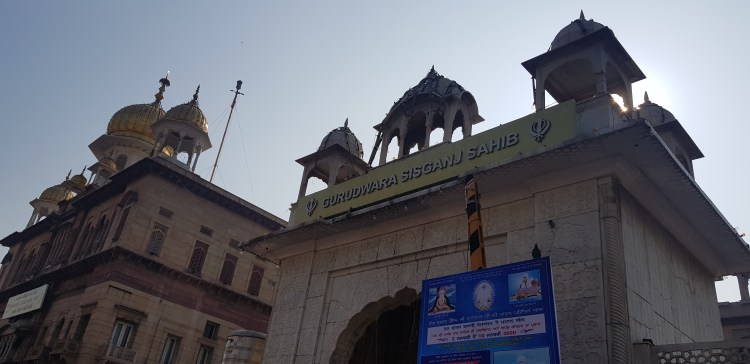
Opposite to it is Bhai Mati Das Museum that narrates a brief life history of the ten Sikh gurus through portraits and descriptions. The construction of a museum makes the people better acquainted with the Sikh culture and helps them understand the history of the religion which strengthens their current beliefs and faith. The museum was established in 2001, marking a modern approach towards the development of religious institutions.


The tradition of ‘langar‘, an old practice of the Sikh religion, whereby a vegetarian meal is made in a community kitchen and served to all visitors, free of cost, is also followed in the gurudwara. It has a langar hall where hundreds of people throng to be fed by the many people who work or engage in ‘seva’ to help in the process of the langar distribution.
Walking towards the right direction from the gurudwara one can find the Central Baptist Church which is one of the oldest churches in Delhi. The Baptist Missionary Society, London, purchased the land near Red Fort in the eighteenth century. The church was established in 1814. It is also known as the “Mother Church” as it has raised several preachers and pastors who have gone on to lead in other churches of north India. It has a European architecture and has been maintained as it was. The religious diversity is commendable in the street of Dariba Kalan. The church opens at 6 pm and people flock there to offer their prayers.

There is a pervading atmosphere of prayer on the street all day long. Shri Digambar Jain Lal Mandir, located just opposite the Red Fort is the oldest Jain Temple in Delhi. The famous bird hospital is built in the same premises in a second building. The temple adds to the commercial earnings of the hawkers, who sell fresh flowers required for worship, along with clips, bags, socks and sweets.
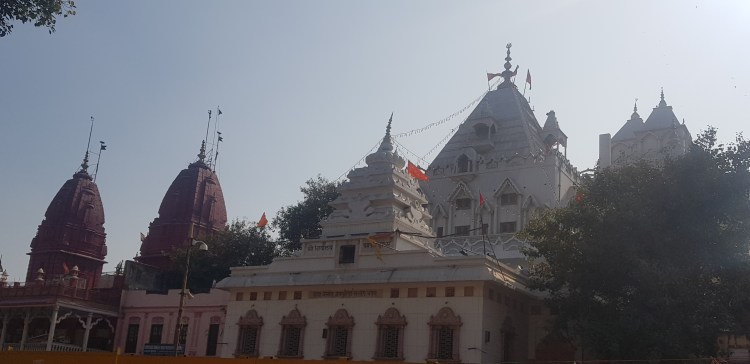
Another important point of attraction is the Jama Masjid, that stands erect and strong despite suffering violent attacks in the past. The grandeur of the Masjid strikes the eye when hundreds of people gather to read the Namaaz and the whole arena resounds with the holy prayer. It brings a peace and calm to the visitor amid the clamour of the city. A few moments of devotion are an escape from the unstoppable life of Delhi. The eateries present around Jama Masjid serve some authentic non vegetarian food which people enjoy to the fullest and many make special visits to this area to savour the taste of these food items. The rustic, local surroundings of the place add to the atmosphere of life in Old Delhi. To take a step back from modern food chains and stroll in these lanes, is a recommended experience for every Delhiite.
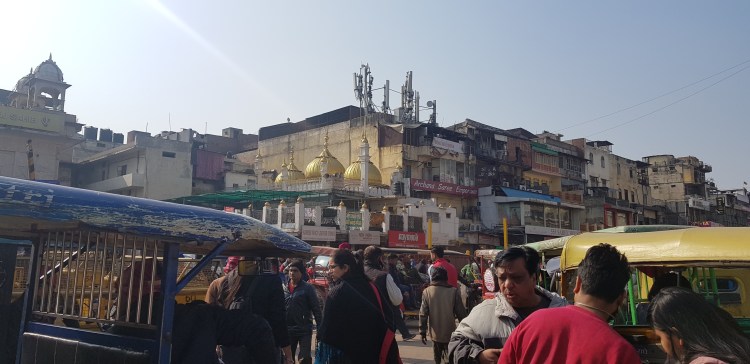
The lived experience of diversity and harmonious co-existence attract visitors to the lanes of Chandni Chowk, where shrines of varied religions are situated. Followers of different faiths unite in the sphere of this busy market and the sounds of prayers in different languages coalesce to form a symphony of diverse tones and meanings. Visiting Chandni Chowk, is an enriching experience for it allows one to behold a rare sight where many religions are practiced peacefully in one street. This is indeed a sight to behold and chance to experience the unity of India.
Written by: Sargam Marwah


 Rediscovering Delhi
Amazingly described❤
LikeLiked by 1 person